THE BEST POMPADOR

Posted in Uncategorized | Leave a comment

Holiday drumming street walk on Montana Avenue


Watch live video from Buddy Helm Drumming on Justin.tv

Posted in Uncategorized | Leave a comment

email question about 7 Essential Grooves

Good morning

Is there any reason I should not use your 7 essential
grooves on a conga? Or does a conga kind of demand
the tumbao style? Also, where does tumbao fit into the
essential grooves?

Thank you very much, R…

……..
Hello Rick,
Good Question. Definitely use the 7 Essential Grooves on the Conga. These grooves are basic patterns that work on any drum. The hand technique may be different but the grooves are universal, So when you understand the basic structures of 4 or 2 and then 3 or 6. Then combine those two in various ways you will use Tumbao as well as many other styles of hand drumming. The tumbao is a pattern that is twice as long as the 7 essential grooves patterns but once you do that doubling in your head you hear the Clave as two measures of the 7 essentlial grooves patterns.
Let me know how it develops.
Thanks for your interest

Posted in Uncategorized | Leave a comment

be sure to vote!

Here is a vintage photo taken back in 1980 in Silverlake, I think.

Posted in Uncategorized | Leave a comment

djembe questions after paralounge

Good morning Mr. Helm
I really appreciate your style and approach to drumming. I have a question
about the use of the djembe when playing with North American music. Would
you take your djembe to practically any musical setting, or is there a more
versitile drum?

Thanks, Rick

Hello Rick,
the djembe is a very versatile drum. I prefer it with most styles of music. It can be played in the traditional style of many different kinds of music. If it is folk music or pop, the downbeat in the middle of the drumhead serves to ground the music much like a conventional drumset. I teach that the downbeat occurs at the beginning of each repeated pattern. Like on the “one” if you are counting in four or in three. In native American the downbeat is still appropriate. It even works in jazz and Celtic. I love it.
Let me know if there are any other questions. Enjoy and share the groove!
Russell Buddy Helm

Posted in Uncategorized | Leave a comment

Drum as manifesting tool

In our meditation drumming groups it has become obvious that there is an energy, maybe many different energies generated by the connection of the drummers through the grooves to the higher consciousness of the Universe. One of these energies is a manifesting ray. I remember it being called “conjuring” back when I was a kid in New Orleans and in the South in Florida. This is not a demonic energy. It is based in true love. Love of oneself and love of our fellow beings. Love of God. It is a powerful energy and can be directed quite specifically to get what we want. There is no devil’s bargain here but you do have to be as clear in your thoughts as possible, and that is where the drum comes into play. The meditation grooves that we have been working with keep us in the Light. Keep us in a more pure state of being because the distracting essence of our critical mind is somewhat suspended and we can see more clearly and feel more intently what it is that we desire. I usually do not talk like this because I prefer to keep the drumming on a mechanical level of words but sometimes I can not refrain from getting metaphysical. There is so much going on with the drum that I have to let some of the inspiration come out in the form of words. Some of this inspiration is no doubt coming currently from a book I am reading that was given to me by a good friend in Gulfport, Florida at the Longhouse meditation and body working center, Andrea and Ken gave me a new book simply called “Anastasia” and it is a wonderful inspirational and entertaining book.

Posted in Uncategorized | 1 Comment

Paralounge!

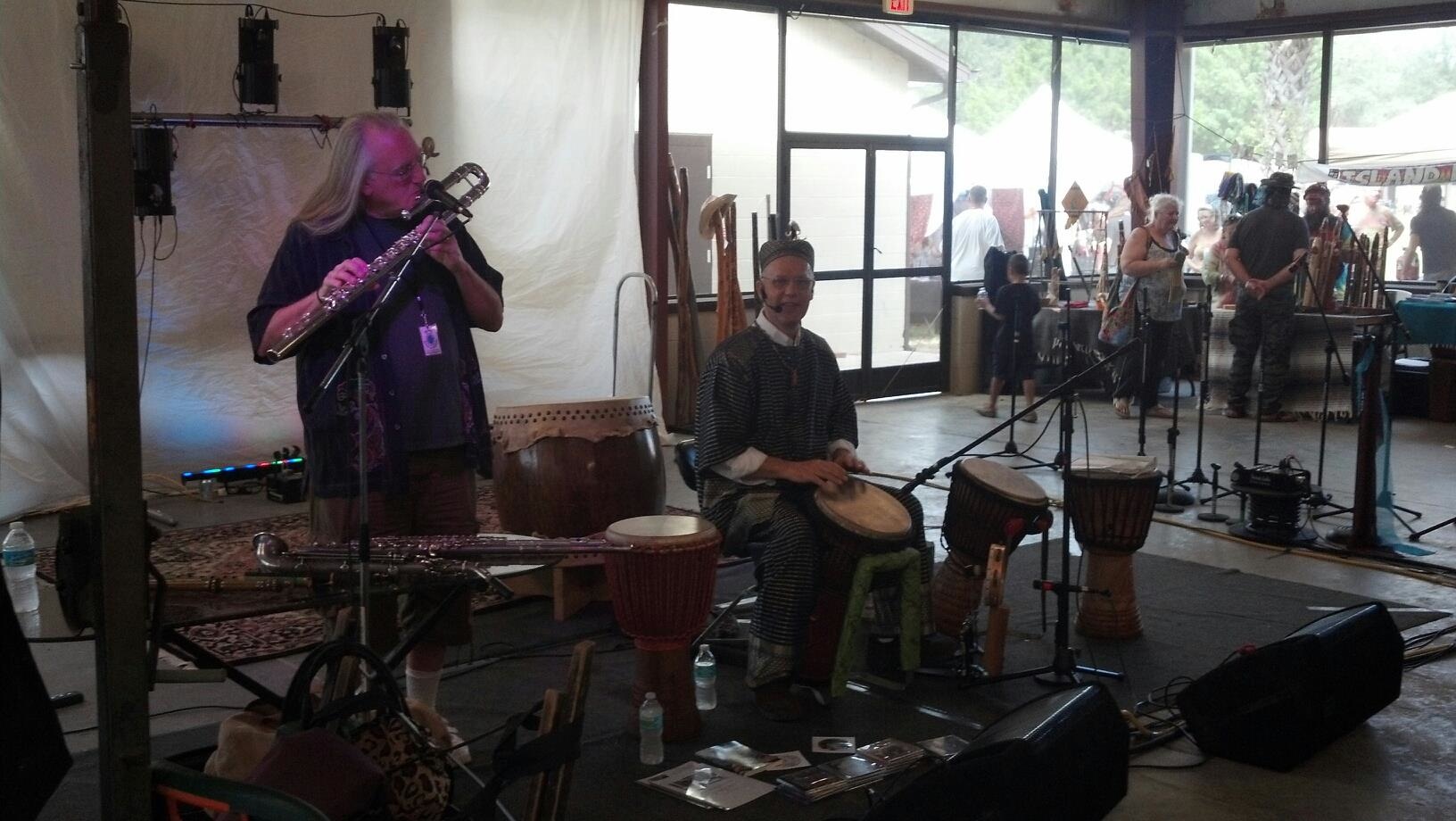
Charlie Dechant playing bass flute with me on the djembe at the 21st Paralounge in Ocala Nat’l Forest in Florida. I did two workshops about the healing meditative aspects of th drum and healing grooves and then laid down some really cool grooves with Charlie. He took time off from his busy schedule with Hall n Oates

Posted in Uncategorized | Leave a comment

Events this weekend

Thursday at Reddick, Florida, Hosted by Marsha Dawes:  Thursday, October 11, 2012  at 6:30PM    $25

Friday and Saturday at Paralounge in Ocala Nat’l Forest Friday my event starts at 1pm so don’t miss it!

Monday down in Gulfport/St. Pete at Longhouse at 7:30


Posted in Uncategorized | Leave a comment

Drumming Therapy at Bridges to Recovery in Pacific Palisades

Drumming Group

What is the Drumming Group?
Why is Drumming effective?
What happens if someone is reluctant to engage in the group?
What should the Drumming group accomplish?
Drumming Therapist at Bridges to Recovery

What is the Drumming Group?
Drumming is one of the earliest forms of communication in human experience and our residential
treatment program integrates this group as one of the components of our holistic treatment
approach. The use of meditative drumming allows an individual to explore their thoughts and
feelings in a nonverbal manner and heal emotional wounds. Recent research has found that
drumming in combination with spoken affirmations can provide individuals with stress relief,
physical relief, and emotional expression. During our residential program, we find that people who
struggle to express themselves in a more typical psychotherapy manner (i.e. verbal expression
of feelings) gravitate toward the Drumming group as a way of finding their voice and developing
images to connect to their unknown feelings and thoughts.

One might think of the Drumming group as one where members are encouraged to participate in
an activity that will most likely be unknown to them but where they are supported and encouraged
to “deal with sophisticated feelings while drumming in a laid back groove” as encouraged by
the Drumming leader, Russell Buddy Helm. Mr. Helm provides the group with the materials
needed for the group and will discuss with them the process of drumming as a therapeutic
medium as the group progresses. Members are encouraged to explore the medium of drumming
as the members of the group develop the quiet rhythm. Following the group, Mr. Helm often
communicates the experiences of the group members to the clinical team so that themes
and issues raised during the group can be integrated into the clients’ ongoing psychotherapy
discussions. Additionally, for those clients that find the drumming to be a helpful adjunct to their
program day, we encourage them to engage in the activity during off-program times and make
materials available to them as needed.

Why is Drumming so effective?
Our treatment team believes that drumming is an integral aspect of the treatment program in
that it provides an entirely different medium for the expression of feelings and thoughts. We
found that when clients found many ways of expressing and exploring their issues (i.e. verbal
and nonverbal) they could approach problems and underlying issues more successfully. The
nontraditional approach toward expression of feelings is an excellent example of how clients
who find themselves unable to discuss painful experiences flourish in an environment free from
judgment and filled with empathy and compassion. For example, a client who experienced a
strong resistance to verbally expressing her frustration with her inability to adaptively manage
her bipolar disorder, found herself drumming in with a cyclical manner, re-creating her internal
experience of her frequent mood shifts. The client was then able to bring into her individual
therapy session how the use of the drum and the meditative aspects of the group allowed her to
find a sense of stability that she sought to integrate into her daily activities. The metaphor of the
drum became a powerful image for the individual as she progressed through her treatment and
learned the skills necessary to move toward emotional stability and interpersonal growth.

We find that the encouragement to express musically whatever comes to mind is the most
valuable to the Drumming experience. Too often, clients are told how to feel or when to express
issues that can often feel controlling and artificial. The encouragement to drum whatever is felt
is often discussed as a liberating statement from the therapist where there is only acceptance of
what is created.

What happens if someone is reluctant to engage in the group?
Some individuals will discuss that they “are not musical” and have no interest in participating.
Our experience has been that if someone is at least open to picking up a drum and creating what
they feel inside, they gain a tremendous amount of benefit. It is often the client who is the most
reluctant to engage that benefits the most from the group as they can reflect upon their resistance
and the learning obtained as a way to overcome other, more daunting obstacles in their outside
life.

What should the Drumming group accomplish?
Drumming should provide an individual with a different way in which to explore their issues and
encourage them to explore nonverbal means of expressing their thoughts and feelings. We find
this group to be a very useful adjunct to the individual therapy as the expression of underlying
issues is often seen in the music created.

Our small milieu of six individuals in each residential program allows for each person to have the
time and opportunity to express their feelings with enough time to feel heard and understood.
Many individuals report feelings of increased self-worth and the ability to identify underlying
traumas in their lives that they wish to change and feel empowered to begin to work upon when
they leave the residential program with the new skill of nonverbal expression of the trauma(s).

In addition, we find that individuals in our residential treatment program report and an increase
in their ability to verbalize feelings and traumas that created difficulty for them reaching their
goals and a strong desire to return to their outside providers with an increase in their emotional
vocabulary, mental strength, desire and move toward a more fulfilling life.

Bridges to Recovery utilizes clinicians who are highly experienced therapists who demonstrate a
strong motivation to help clients reach their full potential and reach their goals and dreams.

Drumming Instructor at Bridges to Recovery

Russell “Buddy” Helm

Posted in Uncategorized | Leave a comment

Downbeat lesson

Hi Buddy
I recently purchased your 7 Essential Grooves and have been watching your u-tube clips. I love your
style and approach. I am older and have been playing djembe for just a few years, but have been looking for
a direction. Your way is both beautiful and solid.
I feel when I am listening to you I lose track of the beginning and end of the phrase and everything seems to point
to the base note. My playing doesn’t quite do that. Can you give me a pointer on how to direct attention to the base note.
Thanks, Rick

Hello Rick,
There are many different ways to play the djembe. Traditional African does not use the concept of the downbeat. The parts are learned and played ensemble.
The invention of the downbeat came out of New Orleans during the Colonial period. It is a quick way for total strangers to play together. The downbeat is the beginning note of a rhythmic phrase based on European notation where the music is in a time signature such as 4 beat or 3 beat or some other permutation of those two basic foundation rhythm structures. The downbeat is at the beginning of the phrase- on “one”. I use the low tone in the middle of the drumhead as the downbeat because it is based on the Rhythm n Blues grooves that we are all familiar with. Soloing over Downbeat based drumming is different than soloing in African in that the soloist needs to support the downbeat in their improvisations This makes a groove that is danceable and can be shared with all levels of ability. The easiest note is the downbeat occuring every 4 beats or every 3 beats and it is also the most important note. Beginners can just play the downbeat and feel included in the magic of the groove.

Posted in Uncategorized | Leave a comment