We’ll always have Paris


excerpt “History of the Groove, drummer’s story” Russell Buddy Helm
©2013 all rights reserved
1987
“I want to drum, but I don’t want to be a Drummer.” Phyllis explained. She was a sweet, grey haired grandmother who walked into Seasons on Montana Avenue, spotted our meager beginning collection of drums; and my handwritten sign I had put up since our return from Bali; “Drum lessons, Dollar a minute”. Next to the Bali drums on a shelf out of the way. People were drawn to them but they weren’t for sale.
Her distinction moved me on a deep level that I could not identify yet it felt very familiar. “What kind of drumming do you want to do?” I asked her. This was unknown territory, I must learn from the students. Thank you to Aileen Trafford, my first drum teacher for giving me an open mind when I was nine years old.
“I just want to drum with myself,.. and my friends, some other women…grandmothers like me…and with my grandaughter.” She spoke carefully, obviously having thought about this need and had already found the words to explain it.
In the year of our Lord 1987 there were no drumming groups. There were no African djembes available to play by hundreds of people like today. There were no drum healers, no drum shamans, no drum facilitators, no certified drum instructors. There was only one kind of drumming; that was for musical accompaniment. Our culture and not yet made a place for sacred drumming. I was having to make this up out of thin air as we went along. I had already made a deal with God, “OK, I’ll play the drums. But I will not play that kind of music that is wrong. I will play….. for You….whatever that was.” I knew it was my gift and my responsibility to play but there was no place for sacred drumming in our culture. I had played gospel, that wasn’t it. Then I remembered Coconut Grove…the magic. The nights, the music…the Caribbean drums. It was what we needed now. It was what I needed right now. Phyllis was bringing it to us. I heard my voice but it wasn’t me.
“There is a low tone in the middle of the drumhead, find that note and keep it steady. There is a high tone out at the edge, hit that once in a while. Just go back and forth, keep it steady, don’t speed up. Just stay relaxed.” I had already come to realize that people could not stay steady, they compulsively would speed up, creating anxiety, sounding aggressive. The steadiness imperative came from my years of training to a metronome. I could play steady for a long time. But this was not metronome drumming, this was more laid back, like rhythm and blues. This was not ‘correct’ drumming. This was funky, sloppy and fun, relaxed and happy. Inviting. inclusive; especially of women. This was the beginning of healing drums. But first of all we had to relax..
“I want to take lessons with you.” Phyllis said earnestly. We set up out back of the store in the yard, under old eucalyptus trees. We tapped along gently for awhile then she said unexpectedly, “You should be recording this.”
That surprised me. “Why?”
“Because you are talking while we are playing; telling stories. It helps.”
I had no idea that I had been talking while we were drumming. Next lesson I brought out a ghetto blaster, put in a cassette tape, put it in record and we started drumming. About half way through the lesson, I stopped and played back what had been recorded. I heard my voice telling stories about the history of the groove. The universe shifted before my eyes; as if some great hand turned the focus knob one big notch. The colors of the tree leaves became vivid green, the sky was bluer than I had ever noticed before. The Universe came into focus in front of my eyes.
I knew what I was supposed to be doing for the rest of my life.
I took out the cassette and handed it to Phyllis, “Here you can keep this. I know what’s going on here.”
excerpt “History of the Groove, drummer’s story” Russell Buddy Helm
©2013 all rights reserved
www.buddyhelm.com

 excerpt “History of the Groove, drummer’s story” Russell Buddy Helm ©2013
all rights reserved
1987
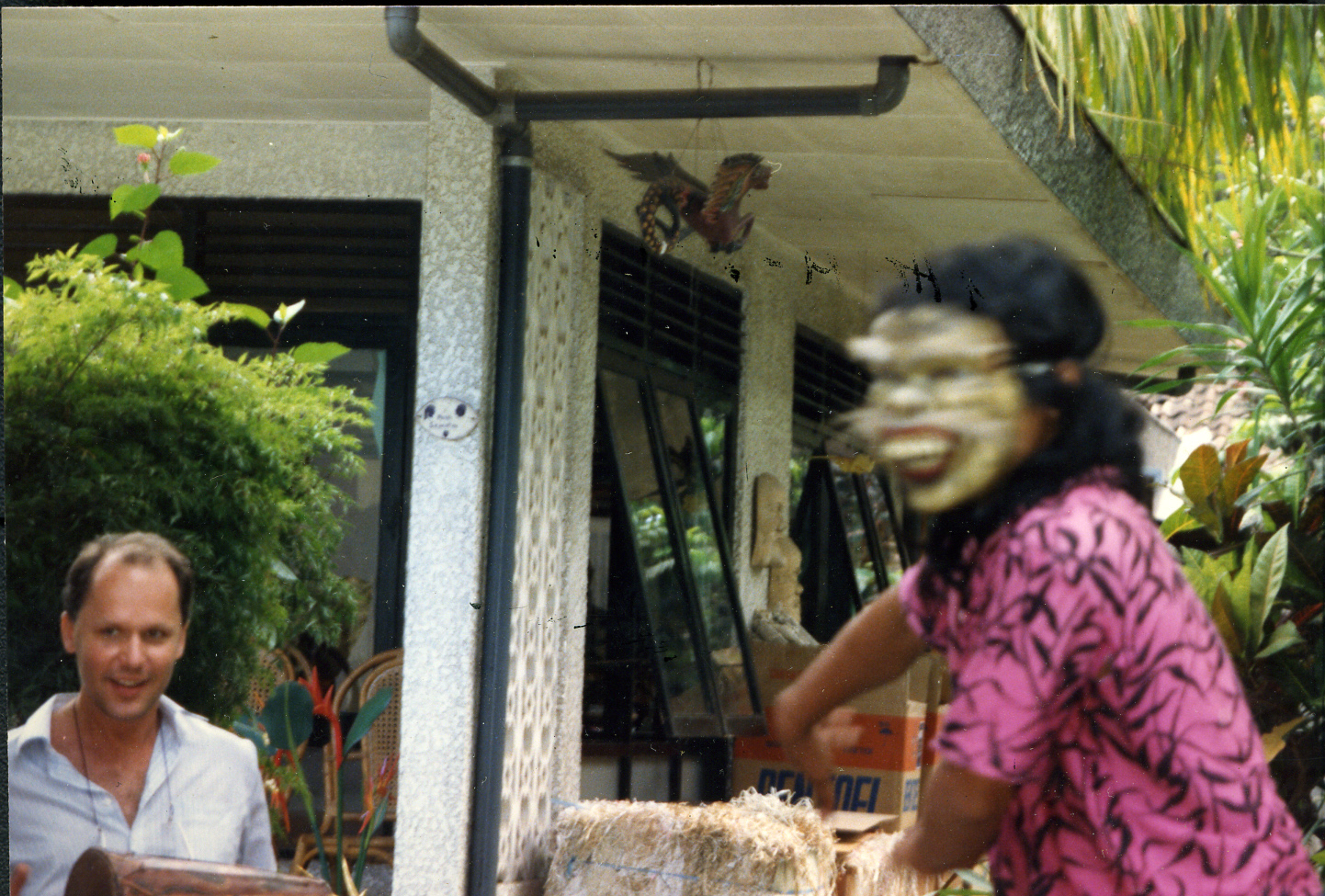
“You are a drummer!” The young Balinese man said in amazement. Cathy and I had found a little shop in the jungle up on the western side of Bali, above Kuta Beach, selling handmade artifacts perfect for her store in Santa Monica. I was along just to help carry. I had spotted a carved double headed dragon drum covered in dust under a shelf, and pulled it out, then tapped on it in the secret six beat pattern to give Cathy some bargaining leverage. He caught me by surprise with his observation.
“No. Not anymore…” I mumbled. I had ceased to be anything after leaving Lorimar, my dysfunctional marriage, that life.. Hearing Tim’s music had reopened a hole in my heart that had not healed. It was a voice calling out to me from beyond the grave.
Charlie had summed it up succinctly on one of his Hall and Oates tours through LA; “You’re the free lance king of Hollywood, Buddy. You can write, direct, shoot, edit, produce….but you are a drummer and you are going to have to come to terms with that, someday.” Questions the Jungian therapist asked me during my two hour lunch sessions triggered unanswered feelings about my father.
A very hot Latin woman walked into my office one day, “You don’t know who I am..”
“Yes I do. You’re a film inspector.” One of the hundreds of employees under my control. She smiled a dark sexy smile, “No I’m not. I am a spy. I work for the front office. They really like you. They don’t want you to quit. They are making you a Vice President. Why do you want to quit?” The only reason I could give her sounded very odd to both of us. “I am a drummer.”
That surprised her “Congero?” “Si, timbalero, todo. Drumset; everything. I grew up in Miami.” That turned her on. “We must dance.” She offered. I thanked her but I still walked out.
I met Cathy through a friend and offered to help with her store. She asked if I wanted to go to Bali with her on a buying trip, so here we were, driving a right handed jeep up through the jungle looking for bargains.
The young Balinese man insisted, “No!…You are a drummer….now!”
I also insisted, “Not anymore. Dead rock stars, thieving managers, corrupt record companies. I don’t do that anymore.” I stated a little more bitterly than I had intended. It didn’t phase him. He put his hands together in the ‘Namaste’ gesture that means, ‘I see the God in you.’ I acquiesced, then said, “Ok. I’m a drummer. So what?”
“Then play!” He smiled with totally joyous conviction. He ushered us out into the jungle clearing and called for a young man who appeared from the back of this thousand year old jungle compound. The store salesman gave us both drums as the pitted ancient Krishna statues watched down over us. He then showed us a wooden monkey mask his grandfather had carved, with long white mustache and long white eyebrows. He put it on while the young drummer and I played around finding a groove we both could play together. The polite young drummer didn’t speak any English. His eyes widened when he heard me play but he didn’t back down, he jumped in and we went for it. Once we got going, the man in the monkey mask was transformed, and began to dance in long, slinky, low, slow moves. He squatted down and moved like a serpent, feeling the air with his long arms. The groove started to take hold of us. I looked up into the golden green sunlit banana palm leaves and began to feel good. Better than I had felt in a long time. I was remembering who I was and how much I loved drumming. We drummed for hours. It was timeless. It turned into a festival. People came out of the jungle with food carts. Two policemen riding tandem on a motorbike stopped in to enjoy the event. I found out later this was the ‘Hanuman’; the monkey god dance. It is an ancient exorcism ritual. It moved something inside of me. I felt the change in my heart. I remembered how much I loved drumming; since I was eight years old it was what I had done and how I had identified myself. When we arrived down in Kuta, the word had spread. A Balinese man came up to me on the street, “Drums Patina!” He kept repeating. Finally, I understood that he had antique drums for sale that had polished shiny patina from the cloth robes of the master drummers holding them between their legs for generations. They had snake skin heads and had real magic in them that I could feel.
“Take these drums back and heal your people.” He said urgently. It was more than a request.
excerpt “History of the Groove, drummer’s story” Russell Buddy Helm ©2013
all rights reserved
www.buddyhelm.com
excerpt “History of the Groove, Drummer’s story” Russell Buddy Helm ©2013 all rights reserved
1986. ‘Dallas’, ‘Falconcrest’, ‘Knots Landing’, ‘Hunter’, were just some of my shows I had to put out the fires on, every day. I was Supervisor of Master Tape Services at Lorimar/Telepictures in Culver City, California, located on the MGM lot where we used every sound stage for our weekly episodic shows. We were the biggest, most successful production company in the film and television industry. I had to make sure all these shows and others got finished, and on air, worldwide. There was a huge map of the world in my office, twenty feet long and ten feet tall. We shipped television shows to countries I had never heard of. My only consolation was that when our shows aired in hot spots like Beirut, Belfast, Joberg, people stopped shooting each other and watched Americans shooting and stabbing each other in the back.
No one knew me as Buddy Helm, no one knew I was a drummer. The marquee outside my office door simply read: ‘Russell Helm’; soon to be the youngest vice president at Lorimar. I was miserable. A colleague suggested that I put a radio in my huge grey office and listen to music while I argued with producers and post houses on the phone. I couldn’t listen to music; it hurt too much.
The front secretary called me, “Excuse Mr. Helm, but we have had several phone calls asking for a ‘Buddy Helm’. Since you are the only Helm on our list, I thought you might know who that is? We have no record of a…”
“That is me.” I said with as much control as I could muster, I didn’t want to sob it out to the front desk. “Rather..that WAS me… Who is trying to reach me?” The secretary responded apologetically, “They didn’t say, Sir.”
“If they call again, just connect them to Dawn, my personal secretary. Thank you for letting me know.” I felt a twinge of the old magic. Who was it? Someone was trying to reach me; calling from my distant past, another lifetime. Someone from the Grove? Someone else?
I called John Herron, Tim Buckley’s last piano player. He had stayed in touch through my change of identity; “Judy Buckley is trying to reach you.” She had tried to call the switchboard at Lorimar and had asked for ‘Buddy Helm’. They had no idea who she was talking about.
She received bootlegs of all the live Tim Buckley shows from Europe. “Warners is distributing under the table. Since you’re a suit now, she wants you to help get royalties.”
I looked at the articles from Europe, “Tim Buckley, Godfather of New Wave.” I looked at the bootleg albums. I read the heated cult articles about how Tim had defined the new music; how singers like Johnny Rotten and Chrissie Hynde had been influenced by his courageous vocals. My heart broke all over again when I listened to the live recordings from the Starwood we had made when I rejoined Tim’s band. I took the cassette tapes and albums home with me, driving up into Laurel Canyon, shutting the door so that I would not disturb my wife or her two children. I listened and I realized it was good. It was really good. It was great.
Judy ran it down to me, “I get a hand written note once a year, from Tim’s ex manager, saying how much I didn’t get because of expenses. When Tim died, I got a bill from the record company for six figures. I paid it off little by little, with my sewing business. Taylor, Tim’s adopted son had nothing. Judy, Tim’s widow, had nothing.
I called Lucy, VP of film at Warners, she had been the partner of Peter Ivers. She undertstood. “I need a sympathetic ear in your music division and a sit down with your music lawyers.”
“Sure.” she replied. I never could have done that when I was a drummer.
Getting onto the Burbank Warner lot is harder than getting into Fort Knox. They waved my nineteen sixty six Mercury Parklane with the reversed back window breezeway right on through and gave me a VIP parking space. I walked down the hall in a daze, remembering the first time I had met Tim. Someone reached out and gave me the iconic cut off denim jacket worn by Bruce Springsteen, the boss. As I walked down the hallway, I looked at it, wondering who had just handed it to me. I was wearing a Barney’s white raw silk suit; picked out for me in New York by Rose, the Polaroid TV commercial producer at the DDB Ad agency; it was designed to impress anyone. I put Bruce’s denim cut off jacket on over my Barney’s white raw silk suit and walked into the conference room. Maybe Bruce’s jacket scared the music lawyers sitting at the huge mahogany conference table more than my Barney’s suit, or maybe I scared them just by being that crazy. I don’t know. I was on terra incognita.
“You all know who this jacket belongs to…”
The six lawyers nodded silently. They had instructions to give me as much credibility as they could. “He used to sit and listen to Tim Buckley at Max’s Kansas City in New York…taking notes.”
“There isn’t enough money to get concerned about here…” One of them chimed in.
“It isn’t about money.” I said, locked into my mission. “You owe…you owe the widow…You owe me, but I’m not going there…” They were uncomprehending. “Its about ethics…I know you don’t know about that but I am here to explain it to you…”
Survival grooves are what distinguishes tribes from one another. When George Washington created the Continental Army, he instructed the military drum teachers to create unique drum beats to use in the field of battle, that would not be confused with the traditional British drum tatooes used to signal maneuvers to the foot soldiers in the din of battle. That’s when Rock and Roll was created. The drum teachers in Williamsburg, Virginia listened to the slaves, the Indians, the Spanish, The Irish, the few Orientals and anyone else keeping a groove and came up with the Thirteen American Drum Rudiments that have since become the worldwide foundation for modern rudimental drumming. Slave ships crossing the Atlantic realized that more souls survived if there was a djembe on board playing their tribal survival rhythms. When the slave ships arrived in Savanna, Georgia and the other East Coast slave ports, the drum was taken away because it was non Christian; a tool of the devil. And worse: it was a tool of insurrection; the djembe revolution. The plantation slaves had drummed to each other, organizing a rebellion, down to the minute, where the slaves broke free of their plantations all along the Eastern Seaboard, communicated by the drum, just like they had back in mother Africa; only there was no place for them to escape to.
New Orleans was a completely different story. The slaves were allowed to mingle, and bring their drums on shore with them and play with people of other races in what came to be known as ‘Congo Square’. This was the birthplace of one of the most important social tools in the modern world; Jazz.
The six beat pattern is the foundation for almost every culture’s power grooves. Slowly play back and forth with both hands and count to six. Each time you hit the ‘one’ hit the downbeat in the middle of the drumhead and keep going. Six beats will get you anywhere you want to go. Saladin used it to defeat the Crusaders, John Philip Sousa used it to inspire generations of U.S. Marines. Every Christian soldier sings to the six beat. Every blues player in the South sings to it because it came from the African Rumba. Every Irish man can dance a jig to it. Every Muslim can put themselves into trance and call to Allah with it. The six beat rhythm knows no doctrine. It is the ultimate survival groove for anyone who wants to use it. What it does to the brain is what got me interested in drumming as a therapy tool. I had played it on Tim Buckley’s version of Fred Neil’s ‘Dolphin’ song.
exerpt “History of the Groove, Drummer’s story” Russell Buddy Helm ©2013 all rights reserved
www.buddyhelm.com
Daryl Hall and John Oates both nodded at me.
excerpt “History of the Groove, a drummer’s story” Russell Buddy Helm ©2013 all rights reserved
Hall and Oates both nodded at me. “Yeah, Mark discovered us. He wasn’t kidding.”
1984. I had gotten a call from a guy named Mark in New York who somehow received a copy of my single called, “Dancing on the Titanic”. He really liked it and wanted to try to place me with a label. He claimed to have made the careers of Daryl and John back when they were unknowns. The timing was such that Charlie and they were performing at Irvine Meadows, so I went down and talked to them. Even Tommy, their manager agreed. “Yeah. Mark is for real.”
“What would you like?
What would you like?
What would you like to do tonight?… On the Titanic. On the Titanic.
Would you like to dance?
Would you like to dance?
Would you like to dance with me tonight? On the Titanic. On the Titanic.
(SOS)
Moonlighting shining on the sea tonight.
Stars are dancing in your eyes so bright,
After all these years we meet,
Funny how things work out so neat.
(SOS)
Finally got it right,
Finally got it right,
Finally got it right with you tonight… On the Titanic. On the Titanic.
Do you wanna dance?
Do you wanna dance?
Do you wanna dance with me all night? On the Titanic. On the Titanic.
(SOS)
Icebergs drifting on the sea tonight
Shining softly in the pale moonlight
I feel so lucky that you’re here with me
Is this the way that it can always be? (SOS)
What would you like?
What would you like?
What would you like to do tonight? On the Titanic. On the Titanic.
Would you like to Dance?….
Would you like to Dance?…On the Titanic
Would you like to Dance?…On the Titanic
Would you like to Dance?…On the Titanic
Would you like to dance with me, on the Titanic? On the Titanic. On the Titanic…”
We rendezvoused at KPFK on a Monday night where Johnny Otis was spinning old R n B tracks. Johnny Otis was an institution. He had plenty of hits including, “Hand Jive”, back in the day. He graciously invited me into the control room stacked with crates of his record collection he played on his show. I looked for my Big Joe Turner Album but couldn’t find it.
“It’s funny that I liked this song. Normally I go for drummers.” Mark said.
“I am a drummer,” I said, coming out of the closet.
New Years eve party at his house, I met A and R men from CBS and a few other labels. They heard the track. It was a little dark for their tastes.
“This is weird. I like the song but it makes me depressed.” the CBS A and R guy said. They were so far away from the punk/New Wave music scene, they did not get the joke of the song.
“We’re looking more for another Michael Jackson…” He said in that dismissive tone when they know they are axing someone’s career. He went to refill his glass and load up on more canapes.
I made a video, transferring film footage from the Barbara Stanwick movie. There were only a few black and white historical pictures of the the ship so I luminence keyed them into the video and had me singing on the deck and on the main stairway. I also shot some bubbles from Ron Sill’s hot tub and danced over those.
The movie came out years later and I could not prove that the story concept had been lifted from my song.
excerpt “History of the Groove, a drummer’s story” Russell Buddy Helm ©2013 all rights reserved
www.buddyhelm.com
Hef was on the red phone
excerpt from “History of the Groove, a drummer’s story” Russell Buddy Helm copyright 2013 all rights reserved
1984. Hef was on the red phone, I let the video editor take the call in the Playboy Channel video editing/screening room that had a real, wrinkled, grey twelve foot long elephant hide couch. I didn’t like to go in there, let alone sit on that horrendous piece of furniture. Besides, I was busy looking out the window from my office at Playboy Enterprises. Actually, it was a narrow window in the hallway on the sixth floor, right outside my office. I could look down the hill onto La Cienega. This was a daily habit. The entrance to the Le Parc hotel and a section of the pool was the only thing I could see from this angle. It was the legendary rock star hang out in West Hollywood. Aerosmith was disgorging from a limo, groupies in tow, soon they were lounging, near naked around the pool drinking Mai Tais and playing grab ass with groupies in bikinis. I had watched lots of different acts, even Charlie with Hall and Oates when they had ten singles in the top one hundred on Billboard. Charlie didn’t play grab ass. He was a family man and kept to himself.
It was very hard for me to even listen to music, let alone play it or witness others playing. I could not understand what had happened. I had stayed clear of all the pitfalls; the drugs, the wild escapades, the bad business deals. Yet I was still in shock from Tim Buckley’s murder, and the brutal beating death of Peter Ivers. Anyone I wanted to play with said things like, “I’m not playing with you, man. Everyone you played with is dead!”
I tried to do it right, and here I was; traffic manager at the Playboy channel. Everybody but me thought it was the coolest job. My new wife had insisted I get a job with benefits, so I had called up Merv Griffin’s Transamerica Video, the post production house where I had just finished editing music videos. Terry Bozio, the drummer for Missing Persons and I got along pretty well in the editing bay; we both had a sense of timing and we both had played with Frank Zappa. I called Playboy Enterprises and told them I was qualified for their position of achivist/traffic manager and the head of post production at TAV would vouch for me. Every morning, I emerged from our hobbit like Lookout Mountain bungalow hidden among the old oak trees up in Laurel Canyon just below Paul Rothchild’s land he bought with proceeds from producing the Doors and Janis. I would crank up my green mint condition Sixty Six Mercury Parklane with the breezeway rear window, put it into neutral and coast all the way down out of The Canyon, past Three Dog Night’s house, past Frank Zappa’s old house, downhill past the Countryside grocery store, past Van Dyke Park’s old house on Penny Lane, timing it to take a right turn onto Sunset Boulevard, still in neutral, and ease it past the Chateau Marmont, where Belushi recently shucked off his mortal coil, trying to keep enough momentum going to pass the Hyatt House, or the “Riot House”, aptly named by the rockers tossing TVs off of the upper story balconies. The Nineteen Sixty Six Mercury Parklane was the longest production car ever made by Detroit, and the heaviest, with the most chrome on it, with a massive four hundred forty cubic inch V8 and four barrel carb, considered by many to be the ugliest car ever made by Ford; it made the Edsel look charming, and by now it was rolling very slowly down Sunset Boulevard. The Mazeratis and Porsches screamed around me. I eventually would put it into drive before turning left onto La Cienega then coasted into my parking space in the lot at the Playboy Enterprises twelve story edifice across Sunset from Tiny Naylor’s, the greasy spoon where Rodney Bingenhiemer the KROQ DJ would hold court. My mother back in Florida, thought I had finally settled down and gotten a good job. Scott, the president of the Playboy Channel liked me. I was making him look good. He would soon jump ship to run the brand new Fox TV as a result of my good work organizing the notorious Playboy Channel. I was putting together a computer management and production system on their IBM mainframe at a fraction of the projected cost. My sojourn up at Stanford Research Institute had served me well. I could talk to the programmer when no one else could. He had worked for NASA, so all I had to do was show him a photo signed by Commander Lovell who had taken it from Earth orbit showing the Eastern Seaboard from Coconut Grove all the way up to Cape Cod and he had signed it “To Bethlehem Asylum”. This really impressed the Playboy programmer and he made up a showcase program where all departments could access the Playboy archives. It was the talk of Hollywood production; all the Playboy Jazz festivals, Playboy After Dark kinescopes with Lenny Bruce hosting, featuring live performances by Sarah Vaughn, Ike and Tina Turner, Count Basie, and many other greats. But they could not air any of it because they had not paid musician’s union dues at the time, so they would have to pay the current rate, and they felt that was too much. This is a great loss to the world. I listened to amazing Playboy Jazz Festival live performances by so many great artists which would never be heard by anyone else. There were twelve cold storage vaults full of decades of Playboy footage; more smut than anyone could imagine, and one very creepy, sacrosanct cold storage vault reserved for footage of Hef’s deceased lover; Shannon.
We had to archive all the titles of the films from the cold storage vaults into the new computer program and the vaults were a mess. Film and tape strewn around on the floor. So I hired the only people with strong enough stomachs to view the smut and who were dressed warm enough to survive the freezing temperatures in the cold storage vaults; Punks. The Ramones were in town, playing at the Whisky A Go Go. Instead of going directly inside, I talked to Paul, the doorman/bouncer, fashion horse with rubber bands in his spiked hair. He was taller than me but not as tall as Terry the Tramp and he was scary. Paul and his friends wore leather jackets even in the sweltering LA sun. They were perfect for documenting all the strange films; even sicko super eight smokers from the Sixties.They came into my office with frost on their black studded leather jackets and frozen spiked hair, showing me a list of titles from the vaults, “We want to see these!” They had highlighted the most outrageously pornographic films that Hef was going to contribute to the Kinsey foundation upon his imminent passing.
I fit the Playboy image; tall, thin, pale. If they had asked me to smoke a pipe and wear a sportcoat with leather elbow patches like the other guys, I probably would have by then. Although the elbow patches reminded me of the CIA; one of the guys trying to impress me when I was nineteen was an operative with suede elbow patches on his hounds tooth sport coat. He and the Farah Fawcett clone smiled huge toothy grins at me in the Chinese restaurant back in Georgetown saying, “Sorry we’re late for dinner. We just flew in on a military transport from Marakesh where we broke up a hashish ring.” That was the last straw for me back then. I would never work for someone with suede elbow patches. Their fashion sense offended me then more than anything else. But now I suppose I was eating my share of crow.
My secretary was a young, gorgeous, statuesque African American woman from South Central LA. When she walked by, all conversation stopped. She was very sweet and a good worker. One day, I saw the parking lot attendant, an African American young man, hitting on her hard. He wouldn’t leave her alone, so I called her into my office. She explained that he would block her car as she was trying to leave the parking lot at the end of the day. She did not know about sexual harassment. I hand wrote a memo to the building superintendent explaining the situation and that we did not want a sexual harassment suit against Playboy Enterprises, so he had better do something immediately about the young man; preferably not fire him, but get him into another position where he would not bother my secretary. When she read my handwritten notes as she typed up the memo she realized it was about her and she came in, thanked me and hugged me gratefully, and kept thanking me profusely. She was a little too energetic and I had to ask her to stop hugging me. She was incredibly grateful; she had never been shown that her sexuality could be defended by legal means. Now she could hold her own against this stalker. He was transferred to another job. She went on to become another executive’s secretary when I left that smut factory. But she had a new self attitude and I was glad about that. One less victim in the world is a good thing, even if it’s at the Playboy Channel.
They asked me what the password should be to get access to the fabulous new computer program. I told them, “Kama Sutra”, which I thought was appropriate. “Too complicated.” The administrator said. “We already have it: It’s your name.” Great…
George Lucas looked up and asked me, “What do you do for me?”
excerpt “History of the Groove, Drummer’s History” Russell Buddy Helm ©2103 all rights reserved
1978. George Lucas looked up at me and asked me, “What do you do for me?”
“I write the Star Wars comic strips. ” I said as nicely as I could. This was one of those situations where my delayed stress could trigger an inappropriate remark.
“Good. Good.” He said. I was trying to slide down the edge of the kitchen counter so I wouldn’t be so tall. It is not good to be taller than the King.
My editor had been at Motown, and asked me one day, “I got a job offer from a film company. They’re not big, but they’re growing. Should I take it? ”
“Never turn down an offer to gain power.” I said as wisely as I could. She took the job and hired me.
I loved the idea of writing about The Force. Since reading Wilhelm Reich’s lab reports defining his discovery of the life force, calling it Orgone, back in Coconut Grove, I had studied esoteric energy systems, trying to understand what our higher human potentials were. I was starting a novel about a young psychic spy. But my children’s science fiction stories got me the job with Lucasfilms. George didn’t want me to write about the Force though. He had copyrighted that term and was keeping it all to himself. So I cranked out weekly episodic comic strips that ran daily in over three hundred newspapers around the US, the Sunday ‘splash panel’ was a lot of fun to create with our artist, Russ Manning, a famous artist from Marvel comics. George borrowed my ideas putting some of my characters into the second Star Wars movie. No one at Lucas knew I was a drummer but my editor. It was still considered questionable behavior to be a drummer.
Steven Spielberg was getting the angel food cake out of the oven. They were having a baking session at the Egg Plant, George’s secret enclave across the street from the Universal Black Tower. The kitchen was as high tech as the bridge of the Millenium Falcon, there were a few other employees and George asked them, “What do you do for me?” One said he was an account, and that really pleased George. They had some cake.
My editor handed me a script. “Don’t tell anybody about this script. Just give us your report.” I read it and it was kind of dumb. “Saturday morning matinee kind of cliffhanger sequences with lots of special effects that you’ll have to invent the technology for. The women character isn’t real; sort of a man in a dress. ” It was ‘Raiders of the Lost Ark.’
They nodded. They came back to me. “We liked your coverage on this. Tell us what you think will be the sequel if we go with this.”
“Wellll…” I suddenly felt important. “You’re going into metaphysical territory; sword and sorcery stuff like Conan the Barbarian. ”
She frowned, “What is that?”
“The Hyperborian thief King? You don’t know?” Charlie had turned me on to all this science fiction/fantasy literature back in Coconut Grove with the Bethlehem Asylum. He had a full collection of science fiction and fantasy paperbacks, including all the Zap comics and every Hit Parader ever printed. Jim was a walking sword and sorcery hero in his everyday life; the grove was his perfect fantasy kingdom.
I wrote the Star Wars comics for a few years and was invited to move up to San Rafael to Skywalker ranch but it was too cold for me. I was used to Coconut Grove weather. I had given up on mainstream music, it was hollow and meaningless, and my style of playing was too funky for most groups. A producer convinced me to get into the punk music scene even though I wasn’t interested and write some screenplays based on that world. I met Rodney Bingenheimer, the DJ on KROQ. I designed a Star Wars character after him called, “Rodno”. I recorded a Doorsish/Joy Division love song on a tiny Casio with a rudimentary drum machine and called it ‘Dancing on the Titanic’. Rodney still plays it on the anniversary of the sinking of the Titanic. The bass player from Tim’s last band paid me to come and play with Diana Harris and the Tuftones, and we got voted best New Wave trio in LA. I wrote several punk comedy sci fi music screenplays, “War Zone, and “Saint Sid” that didn’t get produced but set the tone for the future. “The Dead Boys” a famous punk band in New York was the band for the movies with a new actress named Susan Sarandon. Stiv Bators, the lead singer turned the scripts into his new band, “Lords of the New Church” and sold a lot of records in Europe. He was friends with Sid Vicious. John Herron, the keyboard player from Tim Buckley posted a sign on his front door; “Wanted: drummer with a sense of humor.” My days as a happy go lucky drummer seemed to be over. “Decline of Western Civilization” was a documentary about the LA punk music scene. I appear at the beginning, standing perfectly still in the middle of the mosh pit, wearing a stingy brimmed hat with buttons on my lapels, while everyone else is frantically pogoing around me. I showed up at most of the punk concerts, some of it was fresh and vital and reminded me of the drive and energy the Asylum had live, and Tim too, but I didn’t feel like I fit in. I edited the first video music award winner for the country rock group Alabama, edited Missing Persons’ videos, also a video for Sammy Hagar. I shot and interviewed David Lee Roth, Bananarama, Clive Davis, and other celebs in an after hours club on Sunset Strip, with Ron Sill my old film making pal from Coconut Grove, creating MTV, using a unique rhythmic editing style with jump cuts. Music video editing was easy for me because I was a drummer; I understood intuitively that rhythmic cuts would intrance the viewer. That became part of the drumming therapy concepts decades later. Some of my nightclub interviews ended up in the Kennedy Center Festival for the Arts in nineteen eighty three. I was witnessing life, but I didn’t really enjoy much of it. Ron, my writer friend who knew Fred Neil suggested I see a therapist. I did, but that seemed fruitless. I was a drummer, and what therapist could understand that? It was like Jim Lovell had told me only seven years earlier, “I’ve been to the moon, Buddy. How can you explain that to someone who hasn’t been there?”
excerpt “Drummer’s History” Russell Buddy Helm © 2103 all rights reserved
Mike Bloomfield was playing at McCabe’s guitar shop
excerpt “History of the Groove, Drummer’s story”
Russell Buddy Helm
©2013 all rights reserved
1976. Mike Bloomfield was playing at McCabe’s guitar shop in West LA. I was the drummer. Buell, the first bassist for the LA philharmonic and also Quincy Jone’s session bassist called me up, “Just wear your blues outfit.” He said criptically. McCabes is a famous breeding ground; Jackson Brown took guitar lessons when he was a juvenile delinquent. So many played there; Melanie, Joni, Doc Watson, U Utah Phillips, Holy Modal Rounders, Dan Hicks and the Hot Licks, Van Dyke Parks, John Stewart, Lightnin’ Hopkins, Tim Buckley, Spanky, Oz, Maria, Bonnie, everybody; amazing pictures on the walls. It is a high small stage at the end of a raw wood concert room with folding chairs and walls covered with vintage guitars. If you didn’t sound good here, you wouldn’t sound good anywhere else in the world. Mark Naftalin, from Paul Butterfield, was on piano. We had a good couple of sets. They recorded it and it disappeared into the archives of Rounder records.
Forty two years later, after I had become a healing drum shaman as well as a blues drummer, I was sitting with Surakaya, Jumoke’s husband from Ghana. We were transacting another deal for the sacred djembe drums handcrafted by their master carvers. We have been doing business with the same family for twenty six years. The trees are blessed before being cut down in the Volta River Basin on the east side of Ghana, then new young trees are planted. The djembe shell’s solid wood interior is carved out by masters using only a machete because the irregular contours create the warm tones needed for deep toned healing; no machined lathing. The shells are driven by truck six hours across Ghana to Accra where they are cured for a year, going through ‘Hamitan’ season; which translates as ‘Golden Dust’ where the Sahara blows in and gently pulls the moisture out of the wood, creating a djembe that sounds as beautiful as a vintage Martin Dreadnaught; especially when they are played very softly. The goats are blessed and everything is used by the village. The skins are cured, soaked and stretched wet, then shaved by hand using a naked Gillette double edged razor blade held in a curve to scrape off the goat hair in a precise ancient ritual that has not been improved upon. Old goat is better than young goat for drumheads. Each drum is blessed and cured for a year. George Kweku, the master exterior carver etches protective tribal Adinkra symbols into the rich Lenge wood then he waxes them with shea butter. They smell like Africa and they are full of spirit. This is where the Blues comes from; only in Africa, it is not called the blues. It is their eternal, sacred music. On these drums, we can play the survival rhythms that we need, even if we are not drummers. We simplified their ancient rhythms when this drum arrived in New Orleans two hundred years ago, and they are now our survival rhythms; simple, loving songs that anyone can play.
Another man was sitting quietly with Surakaya, but he started to press me for who I had played drums with. I wasn’t that interested in dwelling in the past but he insisted, so I mentioned a few names including Mike Bloomfield. He lit up, “I knew I had heard your name. I have you on that album! Your name is on it! Would you like a copy?” One more album that I made absolutely nothing on but it brought tears to my eyes none the less when I heard it. Mike was a real sweetheart and a grand soul. That kid could play the blues and he could sing the blues too.
excerpt “History of the Groove, Drummer’s story” Russell Buddy Helm copyright 2013 all rights reserved
www.buddyhelm.com
Van Dyke Parks introduced me to Peter Ivers
excerpt “History of the Groove, Drummer’s story” Russell Buddy Helm copyright 2013 all rights reserved
Van Dyke Parks took me under his wing when I first arrived in LA, introducing me to Peter Ivers, a singer/songwriter and Harvard grad in dead languages. He played a mean blues harmonica, jamming with John Cale and that New York Art scene. Peter was with the literati crowd including National Lampoon movie makers, Doug Kinney, creator of Animal House, Harold Ramis creator of GhostBusters. I was somewhat overwhelmed by their snappy repartee. Peter could write really odd songs that eventually came to be called New Wave music. His biggest song was for David Lynch’s underground classic black and white nightmare movie, ‘Eraserhead’. The song, ‘In Heaven, Everything is Fine’ was covered by the Pixies. We also recorded the soundtrack for a Linda Benglis/ Stanton Kaye art movie in the Whitney Museum collection called, “The Amazing Bow Wow”, about a dog that could talk. I played a saw…He was quite an entrepreneur and got budgets for soundtrack sessions with Ron Howard; I played drums on “Grand Theft Auto”, Ron Howard’s first feature. Peter was an underground celeb opening for the New York Dolls at the Hollywood Bowl, wearing only diapers and a harmonica. His live shows usually had a big band. I was acquiring the persona of shaman drummer, playing percussion with strange handmade instruments as well as congas. It was proving to be a better fit for me, since the really funky drumming style I had so meticulously developed in the deep south was not understood that well in LA. Peter usually had an audience full of movie people. His girlfriend, Lucy, also from Harvard, produced Alien, Elephant Man and became the first woman executive VP of Film at Warner Bros. This was all pretty heady stuff for me. I felt like a redneck even if I was from Coconut Grove, but Peter liked my drumming. “You’ve got an infectious beat!” Peter would remark. “Shut up and play.” I would usually respond. Peter wanted street cred and that was his undoing. He asked me to get him a loft in the downtown LA art ghetto in the early eighties. I told him it wasn’t safe, him being a Harvard grad and all that; that he should stay in safe and green Laurel Canyon. Downtown LA was some pretty mean streets. But he insisted, so I hooked him up with an art director who had a big loft to sublease just two blocks from my space. Peter and I went on to shoot several TV shows, “New Wave Theater” on USA cable featuring local punk and New Wave bands in LA like Suburban Lawns, Germs, X, Go Go’s, Fear, etc. It was shot live. I had blond hair, playing percussion in his band, Vitamin Pink. This era was not easy to listen to the music, but it was a lively scene. I also shot a pilot that Peter guest hosted called ‘At Sunset’ which was the precursor for MTV. http://www.youtube.com/watch?v=kSxmWyDU6vw
I’m in the sear sucker sportcoat in the meat locker at the end of the video.
Peter was unfortunately bludgeoned to death in the loft I had found for him. The pain of his loss was compounding the sense of futility and frailty I was feeling about music and art, especially in the big city. I felt very guilty for Peter’s death as well as for Tim Buckley’s death eight years earlier, and also for my father’s death, but I didn’t know that yet…even though I had only been four when he was killed. Loss and grief have no boundaries.
excerpt “Drummer’s History” Russell Buddy Helm copyright 2013 all rights reserved
www.buddyhelm.com